
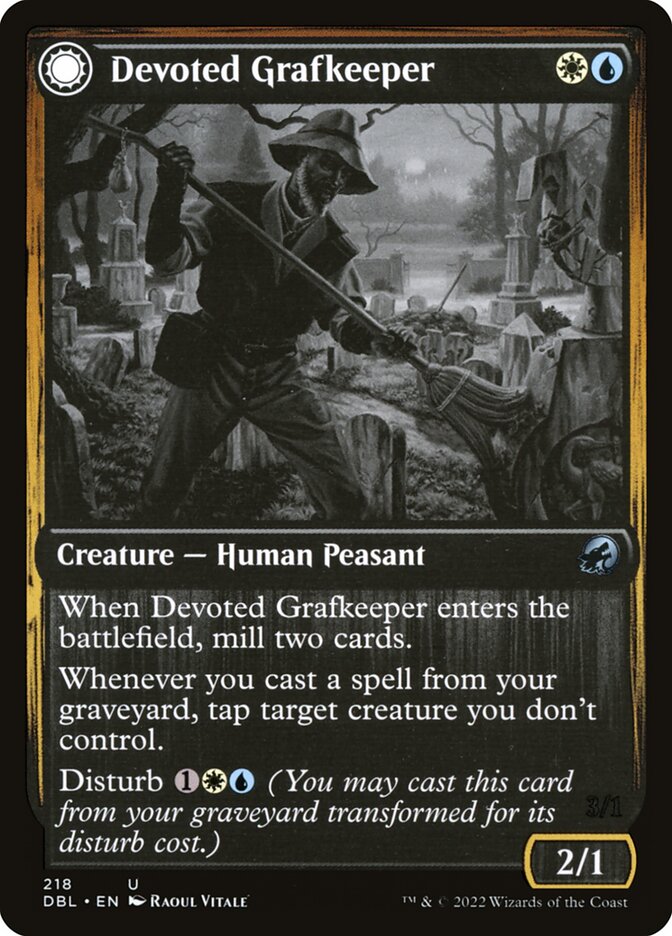
Devoted Grafkeeper // Departed Soulkeeper


When this creature enters, mill two cards.
Whenever you cast a spell from your graveyard, tap target creature you don't control.
Disturb  (You may cast this card from your graveyard transformed for its disturb cost.)
Flying
This creature can block only creatures with flying.
If Departed Soulkeeper would be put into a graveyard from anywhere, exile it instead.
Illustrated by Raoul Vitale
This printing
Prices
"Disturb [cost]" means "You may cast this card transformed from your graveyard by paying [cost] rather than its mana cost."
Disturb is found only on the front faces of some double-faced cards.
The back face of each card with disturb has an ability that instructs its controller to exile if it would be put into a graveyard from anywhere. This includes going to the graveyard from the stack, so if the spell is countered after you cast it using the disturb ability, it will be put into exile.
When you cast a spell using a card's disturb ability, the card is put onto the stack with its back face up. The resulting spell has all the characteristics of that face.
A spell cast this way enters the battlefield with its back face up.
If you copy a permanent spell cast this way (perhaps with a card like Double Major), the copy becomes a token that's a copy of the card's back face, even though it isn't itself a double-faced card.
To determine the total cost of a spell, start with the mana cost or alternative cost (such as a disturb cost) you're paying, add any cost increases, then apply any cost reductions. The mana value of a spell cast using disturb is determined by the mana cost on the front face of the card, no matter what the total cost to cast the spell was. (This is a special rule that applies only to nonmodal double faced-cards, including ones with disturb.)
Printings (2)

Related cards
 Baithook Angler // Hook-Haunt Drifter
 Beloved Beggar // Generous Soul
 Covetous Castaway // Ghostly Castigator
 Dorothea, Vengeful Victim // Dorothea's Retribution
 Lunarch Veteran // Luminous Phantom
 Malevolent Hermit // Benevolent Geist
 Chaplain of Alms // Chapel Shieldgeist
 Overwhelmed Archivist // Archive Haunt
 Mourning Patrol // Morning Apparition
 Covert Cutpurse // Covetous Geist
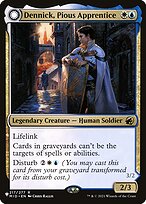 Dennick, Pious Apprentice // Dennick, Pious Apparition
 Katilda, Dawnhart Martyr // Katilda's Rising Dawn